
Evolution Gaming live roulette video
Pragmatic Play roulette video
Playtech French roulette video
Overview – table, bets and payouts
 The premise
Roulette, in all of its forms is really a very simple game to understand.
You have a wheel with 36 pockets numbered 1 to 36 and coloured red or black, a further pocket numbered zero (or zero & double zero pockets), and an accompanying table layout with corresponding numbers and bet options.
You select your bets by placing chips on the table up until the point where the dealer or croupier announces “no more bets” or “rien ne va plus”.
The winning bets will be determined based on which pocket on the wheel the roulette ball comes to rest on. This number is marked on the table by the dealer using a dolly (or electronically in the case of live roulette).
Bets are categorised as ‘inside bets’ and ‘outside bets’.
Inside Bets
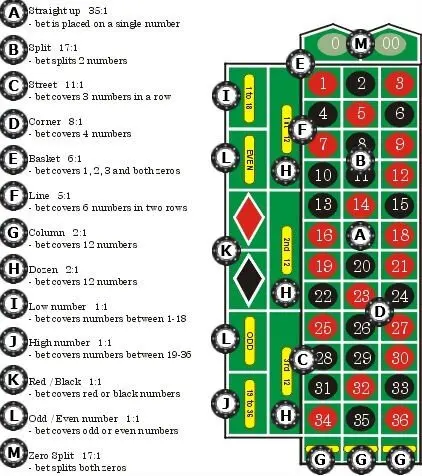
Inside bets are made by placing chips within the 1 – 36 grid and include:
- Straight-up – place chip on a single number in the grid to bet on that single number
Payout: 35 to 1; - Split – place a chip on the line between adjoining numbers to bet on two numbers. eg 22/23, 32/35
Payout: 17 to 1; - Street – place a chip on the line at the edge of a 3 line row to bet on all three numbers. eg 31/32/33
Payout: 11 to 1; - Corner – place a chip on a corner intersection of four numbers. eg 17/18/20/21
Payout: 8 to 1; - Six Line – place a chip on adjoining streets to select all six numbers. eg 16/17/18/19/20/21
Payout: 5 to 1; - Trio (or Basket) (European Roulette) – place a chip on the intersecting point between 0/1/2, or 0/2/3 to bet on three numbers.
Payout: 11 to 1. - Basket (or Five Line) (American Roulette) – place a chip as indicated by ‘E’ above for 1/2/3/0/00 five number selection.
Payout: 6 to 1.
Outside Bets
Outside bets are made by placing chips on the bet options outside the 1 – 36 grid and include:
- 1 to 18 – place a chip on the 1 – 18 bet box
Payout: 1 to 1; - 19 to 36 – place a chip on the 19 – 36 bet box
Payout: 1 to 1; - Red or Black – place a chip on the red or black diamond bet box
Payout: 1 to 1; - Even or Odd – place a chip on the Odd or Even bet box
Payout: 1 to 1; - Dozen Bets – place a chip in the ‘1st 12’, ‘2nd 12’, ‘3rd 12’ bet boxes
Payout: 2 to 1; - Column Bets – place a chip on 12 number column, in the space indicated as ‘2 to 1’
Payout: 2 to 1;
Typically casino will set table limits in respect of both inside bets and outside bets.

American roulette
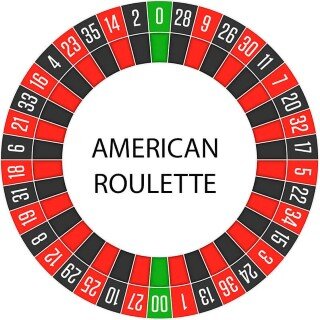
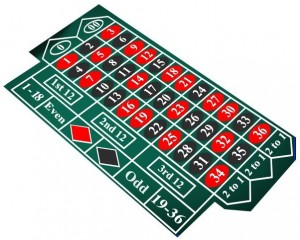
The layout of an American roulette table is the same as that of its European counterpart apart from one key difference – there’s a double zero (00) in addition to the single zero (0). Of course this is also reflected by an additional zero being on the accompanying roulette wheel for the American version of the game.
While this difference is a minor one from a presentation perspective, from a house edge or house advantage perspective it is a crucial one.
Discussed further in our Return to player section, the additional zero makes for a slightly higher house edge by virtue of the fact that payouts remain the same while odds of hitting any selected number are increased because there are 38 possible outcomes rather than 37.
The number sequence on the wheel also differs from a European wheel. Comparing the numbers either side of zero immediately highlights this. The different number sequence does not effect player returns.
European roulette
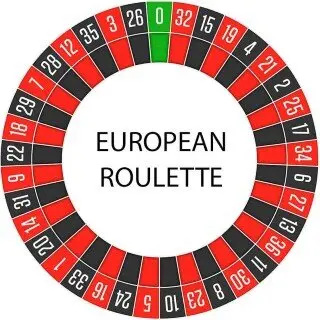
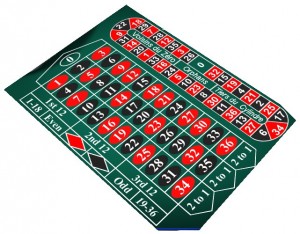
European Roulette has only a single zero on the table layout and accompanying wheel. While this may seem a minor difference from a presentation perspective, from a house edge or house advantage perspective it is crucial.
While the payouts are the same for both European and American roulette, the odds of hitting your selection in this version of game are better given there are only 37 possible pockets for the ball to fall into. This is explored further in our Return to player section below.
Most European roulette tables will also allow for bet groups known as the ‘neighbours’. These are presented for selection on a race track next to the table. More on neighbours bets below.
French roulette
Don’t be too fussed with the different looking table, and French labelling. In most respects this is the same game as European Roulette…. a single zero, an identical wheel and largely the same bets and payouts (albeit named in French of course) as European Roulette.
One difference worth noting is the La Partage rule. La Partage dictates that you lose only half of your bet, not all of it, if you place even money (outside) bets and the ball lands on zero.
Neighbours bets
Neighbours bets are groups of numbers sitting next to each other on the roulette wheel (hence the term neighbours). A racetrack next to the table presents the neighbour bet options, and playing online, allows for easy bet selection.
Racetracks for placing neighbours bets are presented on most live European and French roulette tables.
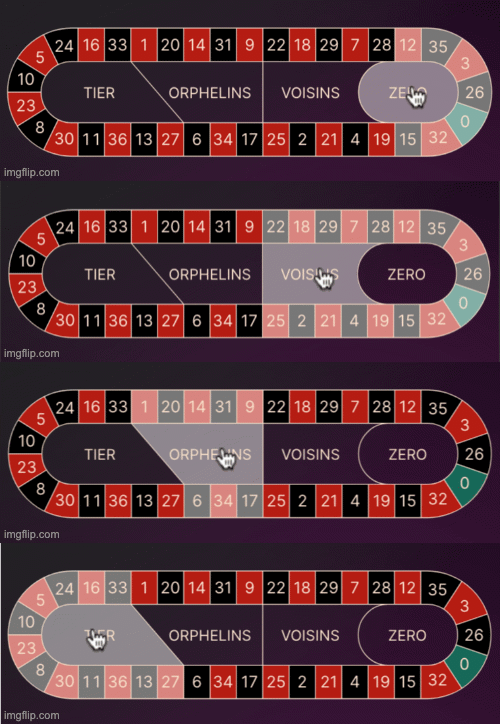
The Jeu Zéro bet covers the number 0 and the six numbers in closest proximity to it: 0, 3, 12, 15, 26, 32, and 35. When selected at a live roulette table, a typical chip placement for Jeu Zéro bet is:
- 1 chip on the number 0/3 Split
- 1 chip on the number 12/15 Split
- 1 chip on 26 Straight Up
- 1 chip on 32/35 Split
The Voisins du Zéro bet includes a total of 17 numbers on the wheel, consisting of the numbers located between 22 and 25 on the wheel’s layout. When selected at a live roulette table, a typical chip placement for the Voisins du Zéro bet is:
- 2 chips on the 0/2/3 Street
- 1 chip on 4/7 Split
- 1 chip on 12/15 Split
- 1 chip on 18/21 Split
- 1 chip on 19/22 Split
- 2 chips on the 25/26/28/29 Corner
- 1 chip on 32/35 Split
The Tiers du Cylindre bet covers 12 numbers: 27, 33 and all numbers between them on the wheel. When selected at a live roulette table, a typical chip placement for Tiers du Cylindre bet is:
- 1 chip on 5/8 Split
- 1 chip on 10/11 Split
- 1 chip on 13/16 Split
- 1 chip on 27/30 Split
- 1 chip on 33/36 Split
The Orphelins a Cheval bet covers the 8 numbers on the wheel that are not covered by Voisins du Zéro and Tiers du Cylindre. 5 chips are placed as follows:
- 1 chip on 1 Straight Up
- 1 chip on 6/9 Split
- 1 chip on the 14/17 Split
- 1 chip on the 17/20 Split
- 1 chip on the 31/34 Split
French Roulette Special Bets
The following special bets are commonly offered on live French Roulette tables, with bet selectors provided to enable easy placement.
Finales en Plein (Endings Straight Up):
- What: Bets on all numbers ending with a specific digit (0-9).
- How: Places straight-up bets on every number sharing your chosen final digit.
- Example: Finale 5 en Plein = Bet on 5, 15, 25, 35 (4 chips).
Finales à Cheval (Endings Split):
- What: Bets on all possible split bets involving a specific final digit.
- How: Places split bets between every pair of consecutive numbers sharing your chosen final digit on the table layout. Covers the same numbers as “en Plein” but via splits.
- Example: Finale 5 à Cheval = Split bets on 5/8, 15/18, 25/28, plus a straight-up on 35 (since 35/38 isn’t consecutive on the layout). Total 4 chips.
Full Complete / Maximum:
- What: Bets on every possible combination involving a single specific number.
- How: Place bets covering the chosen number in all ways: straight-up, plus all splits involving it, plus the corner (square), plus the street (row) it’s in, plus the relevant trio(s) if it’s 0/1/2 or 0/2/3.
- Chips: Varies significantly by number (e.g., ~40 chips for a central number like 17, fewer for edge numbers like 0). Covers 1 number exhaustively.
Asian roulette
Asian roulette is not as common at online casinos as its American or European counterpart, but there is at least one live platform that offers this version of the game so it’s worth a quick look.
Asian roulette is similar in most respects to European roulette (same odds and single zero game) and its key point of difference is the number sequence on the wheel – as depicted below.
From a return to player perspective Asian roulette, like European roulette offers superior returns to the American version of the game.
 |  |
| Asian roulette wheel | European/French roulette wheel |
Return to player considerations
This should be a crucial consideration for all roulette players and it turns to the question of how much money you are statistically likely to win for a given amount invested.
A return to player rate of 95% indicates that for every $1,000 bet on a given game, the mathematically likely return is $950, or a $50 loss. This can also be expressed as a 5% house edge.
Now the bad news is that every form of roulette, whether it be European, French, American or Asian, has an in built mathematical house edge, no mater which bet or combination of bets you choose to make. This is how casinos make their money. But a crucial point worth remembering is that this house edge differs from one form of the game to the next and this difference is brought about by the presence (or absence) of a second zero.
Consider a straight up bet on both an American and European roulette table. In both cases you get a 35 to 1 payout for a hit but the odds of hitting your bet playing the American version are slightly worse than the European version because there are 38 possible outcomes rather than 37. This fact, and the resulting house edge and return to player (RTP) rates are presented in the below table.
| Roulette version | Probability of win | Probability of loss | Payout | Expected value | House edge | RTP |
|---|---|---|---|---|---|---|
| American | 1 in 38 | 37 in 38 | 35 : 1 | -1×37/38 + 35×1/38 = -0.0526 | 5.26% | 94.74% |
| European | 1 in 37 | 36 in 37 | 35 : 1 | -1×36/37 + 35×1/37 = -0.0270 | 2.70% | 97.30% |
| French | 1 in 37 | 36 in 37 | 35 : 1 | -1×36/37 + 35×1/37 = -0.0270 | 2.70% | 97.30% |
Betting Red or Black the RTP is the same for European and American Roulette. French Roulette RTP is higher due to the Rule of La Partage…
| Roulette version | Probability of win | Probability of loss | Payout | Expected value | House edge | RTP |
|---|---|---|---|---|---|---|
| American | 18 in 38 | 20 in 38 | 1 : 1 | -1×20/38 + 1×18/38 = -0.0526 | 5.26% | 94.74% |
| European | 18 in 37 | 19 in 37 | 1 : 1 | -1×19/37 + 1×18/37 = -0.0270 | 2.70% | 97.30% |
| French | 18 in 37 | 19 in 37* | 1 : 1 | -1×18/37 – 0.5×1/37 + 1×18/37 = -0.0135 | 1.35% | 98.65% |
*with half of bet stake returned for loss
The clear message here: avoid American roulette and play European or French roulette if possible. Ideally, play French Roulette sticking to even money bets.
It gets even worse on American Roulette tables if you take the Basket Bet (bet on five numbers – 0, 00, 1, 2 & 3 paying 6:1), also known as ‘the worst bet in the casino’. It has a house edge of 7.89%.
Live roulette playing considerations
By far the most common version of roulette offered in live online format is European Roulette. French Roulette tables are also easy to find.
Given both versions employ the same wheel, some providers will offer either European or French play via the same wheel and dealer. A cosmetic change to the virtual table presentation, and addition of the La Partage rule is all that is required.
If you are determined to hand over more money to the casino, there are also American Roulette tables available.
Use the gallery on the live roulette summary page to select the version you want to play.
What you may also find playing live, is that the time period between spins can differ significantly from one casino to the next.
If it’s a very fast game you prefer, then Speed Roulette from Evolution Gaming or Playtech is probably a good option. The others generally sit somewhere in between.
Also note that table limits differ significantly from one casino to the next. For a comparison of live roulette limits click here.
Roulette systems
No other casino game seems to have as many systems devised and advertised to help players win than roulette. Maybe this is because it is a reasonably simple game to understand, and the systems are typically easy to employ.
Unfortunately many of the better known systems rely on a flawed logic that reasons that past spin results will impact future outcomes. Referred to sometimes as the ‘gambler’s fallacy’ this idea leaves rather large holes in the mathematical soundness of these systems, and means quite simply that they don’t work.
Now where a method can be devised to bring about a player edge on individual spins this is a different story. Wheel bias analysis systems devised around a specific wheel’s tendency to drop balls in certain regions have enabled advantage players to win big – the most famous case of this was Billy Walter’s $3.8 million win at the Golden Nugget in Atlantic City in 1986 on a wheel his team found to have a slight drop bias. Needless to say the Golden Nugget, and casinos all around the world, were quick to invest in new low profile, precision technology wheels from specialists like John Huxley.
Assuming a well engineered, unbiased wheel (as almost all now are) it must always be remembered that each spin of the roulette wheel is an independent event and the odds of winning or losing on that spin are in no way influenced by prior outcomes. Nevertheless, it is fun to to consider how these systems work and the thinking (albeit flawed) underlying them.
Martingale
One of the most commonly discussed and employed systems which forms the foundation of a bunch of variation systems, is the Martingale. The full mathematical analysis of this system is set out at Wiki. The system dictates that players, playing even money outside bets, continue doubling up until such time as a win occurs, at which point all losses are recovered and a profit equal to the original bet amount is made. Proponents of the system reason that statistically a loosing streak cannot last forever and consequently a sufficiently bankrolled player must eventually win.
The problem with this logic is two-fold. First, long losing streaks do occur and even an enormously bankrolled player will run into problems when stakes are being increased exponentially. Second, all roulette tables have limits that mean that regardless of how deep the player’s pockets are, when a losing streak reaches the point where your double-up stake is greater than the table limit, the system falls down. While some commentators claim that roulette table limits were introduced by casinos to combat Martingale players, in truth (backed by mathematical analysis) even in the absence of table limits this system has been proven ineffective
You can read about the Martingale and live roulette here, or roulette systems generally here.
Roulette advantage play
While roulette systems (especially most for sale on the internet!) should be take with a grain of salt, techniques have been devised over time that have allowed advantage players to beat certain wheels in certain casinos. Crucial for this to be possible is identification of a bias in the wheel itself or dealer’s ball spin that can then exploited.
These techniques are based more on physics than mathematics. When measurable non-random elements are introduced into the roulette game by virtue of flaws in physical wheel construct or dealer signature, and the effect
they have on outcomes is observed and understood, the odds can swing drastically in the player’s favor. Some of the better known techniques are discussed in more detail in our blog. They include: